CAIUS LODGE Lodge 3355
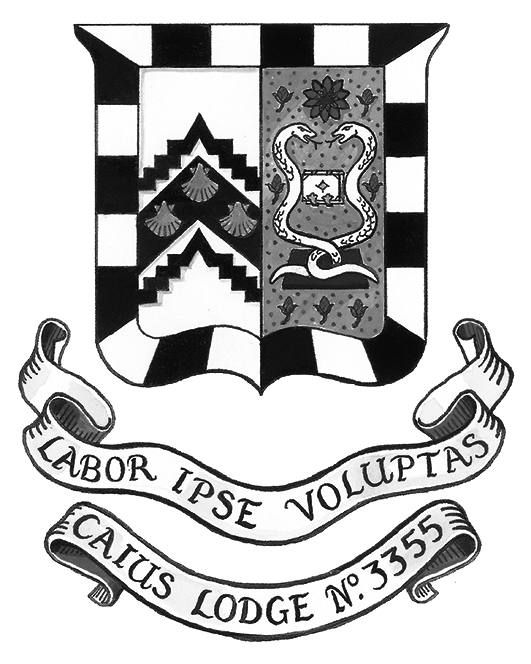
A Brief History of Caius Lodge 1909 – 2009 by Peter Jennings
Introduction
Membership of Caius Lodge was restricted to graduates of Gonville and Caius College, Cambridge, although the United Grand Lodge of England reduced the age of admission from 21 to 18 in 2007 which allowed undergraduates to be admitted, by dispensation. It now also has members who are associated with the College such as donors to the College, members of staff and relatives of other members.
Although the Lodge is associated with a Cambridge College, it is based in London, as this makes it easier for members to attend the meetings.
It became a tradition to have the Installation Meeting in Cambridge once every three years but the visit to Cambridge became so popular this now happens every year, at the end of May or early June. On these occasions the Lodge meets at the Masonic Hall in Bateman Street and dines in College.
Caius Lodge is a member of the Oxford and Cambridge Lodges’ Council which was founded in 1992, when the Lodge hosted the first Annual Festival. There are only two Colleges in each University that have their own Masonic Lodge and Caius Lodge is the second oldest of these. Other members of the Council include Isaac Newton University Lodge No. 859, in Cambridge and Apollo University Lodge No. 357, in Oxford. Other members of the Council include Lodges in Cambridge and London and other Masonic Orders associated with the Universities of Oxford and Cambridge.
Despite the fact that Caius Lodge has an extremely restricted source of recruitment, it has enjoyed a continuous existence since it was founded. Current members of Caius Lodge live in Australia, America, Turkey, Spain, Germany and France. Active membership of the Lodge has been lower at some periods than others but an interest in Masonry, combined with a desire to have a regular connection with the College has always sustained the Lodge.
The Foundation of Caius Lodge
Caius Lodge No. 3355 was consecrated on 8th June, 1909 in the Criterion Restaurant, Piccadilly. There were present: 32 Founders, 15 Grand Officers and 24 Visitors. The Grand Officers included R.W. Bro. Col. R. Townley Caldwell, Provincial Grand Master of Cambridgeshire, V.W. Bro. Sir Edward Letchworth, Grand Secretary, W. Bro. W. Briggs, PGTreasurer, W. Bro. Rev. J. H. Gray, PGChap and W. Bro. R. H. Horton-Smith, PGReg.
After the Brethren had assembled in the Lodge Room, V.W. Bro. Sir Edward Letchworth, the Consecrating Officer, took the Chair and appointed his officers, pro tem, as follows:
V.W. Bro. R H Horton Smith MA, PGReg, as S.W.
V.W. Bro. W Briggs, LLD, PGTreas, as J.W.
V.W. Bro. Rev J H Gray, MA, PGChap, as Chap.
V.W. Bro. F Richardson, PdepGReg, GDC, as D.C.
V.W. Bro. R Percy F W Simpson, MA PDepGDC, as I.G.
The minutes record that after the Lodge was opened in the Three Degrees, it was duly consecrated and ‘all present being much impressed by the able and admirable manner in which the ceremony was done’.
W. Bro. John Stanley Gardiner was then installed as the first Master of Caius Lodge. He then invested his officers, as follows:
W. Bro. W H H Jessop, as I.P.M.
W. Bro. J Keogh Murphy, as S.W.
W. Bro. Harold S Sington, as J.W.
Bro. H Claughton Scott, was elected as Treasurer
W. Bro. T A Wallis, as Secretary
Bro. G H A Comyns Berkeley, as S.D.
Bro. J Blumfeld, as J.D.
W. Bro. F C Wallis, as D.C.
W. Bro. C S Myers, as Organist
Bro. G S Steel, as I.G.
W. Bro. W H Jervis Wegg, as Steward (unavoidabley absent)
Bro. F F Howse, as Steward
Bro. R S Hopkins, elected as Tyler
A pencil jotting in the margin of the minutes notes that Bro. G S Steel, the Founding I.G. was still a subscribing member of the Lodge in 1959!
The Consecrating Officers, together with the Grand Master of Cambridgeshire, Col. Robert Caldwell, and the District Grand Master of Western Australia, Rt. Rev. C O L Riley, Bishop of Perth, were then elected as Honorary Members of the Lodge.
Five brethren were proposed as Joining Members and two Candidates were proposed for Initiation. It was resolved that the W.M., the Wardens, Treasurer and Secretary form a Committee to frame the By-Laws of the Lodge. After the Lodge was closed, the brethren enjoyed the Consecration Dinner in the Criterion Restaurant.
The Early Years
In the early years after its foundation, Caius Lodge thrived. At the 1st Regular Meeting, on 25th November, 1909, the five proposed Joining Members were elected, one of whom was then Passed to the Second Degree. This was followed by an Initiation. A proposition was also passed for a ‘hearty vote of congratulations to the Worshipful Master on his election to the Professorship of Zoology at the University of Cambridge’. At the following meeting, on 24th February, 1910, there were two Joining Members, an Initiation and a Second Degree. At the Installation Meeting on 26th May, 1910, a Third Degree ceremony preceded the Installation of W. Bro. Keogh Murphy and this was followed by a Third Degree – quite a long meeting!
At the Installation Meeting on 26th May, 1910, the following motion was put from the Chair, “The Lodge records its grief and the deep sense of the loss the Craft and the Empire have sustained in the death of King Edward the Seventh and expresses its unswerving loyalty to His Majesty King George the Fifth”. On that occasion, after the second Master of the Lodge, W. Bro. J Keogh Murphy had been installed and appointed his Officers, he was ‘obliged by reason of his duties as Grand Steward to attend elsewhere and his place was taken in the Chair by the I.P.M.’.
An interesting amendment to the By-Laws was passed at this meeting, “Members of the Lodge shall, while resident outside the British Isles, be entitled to pay a reduced subscription of half a guinea per annum or, if preferred, two guineas in advance for five years”. At the meeting on 23rd February, 1911, the Secretary duly reported that ‘Bro. Darley had gone to New South Wales and had paid his subscription as a foreign member for the next 5 years’.
Because of the number of ceremonies that were due to be conducted, it was decided to hold an Emergency Meeting on 25th January, 1912 to consider two Notices of Motion which had been notified at the previous meeting and required considerable discussion. The first was the recommendations of the Standing Committee which provides the first record of fees. These were proposed as follows:
Initiation Fee – 5 Guineas
Joining Member Fee – 1 Guinea Annual Subscription – to include dinner and wine at 3 meetings – 2 Guineas
Non-Dining and Overseas Subscription – ½ Guinea
Dining Fee for Visitors and Non-Dining Members – 1 Guinea
The second Notice of Motion was that the Lodge moved from the Criterion Restaurant to the Connaught Rooms. Both Motions were put to the following Regular Meeting on 22nd February, 1912 and carried unanimously. At this same meeting, it was clear why an Emergency Meeting had been necessary. In addition to three Joining Members being elected, there were Second and Third Degree ceremonies and this was followed by the Initiation of two Candidates! One of these Candidates had matriculated in 1894 and the other Henry Howard Walford in 1906. Bro. Walford was the father of two members of Caius Lodge who were to join in the 1950s and one of whom will be at the Centenary Meeting, having been a member of the Lodge for 59 years.
At the Meeting on 27th February, 1913, a resolution was passed to make a donation of 2 guineas to ‘the Daily Telegraph Fund for a memorial to the members of the Scott Antarctic Expedition, the late Edward Wilson being a Caius man’.
At the following Meeting, on 22nd May, 1913, it was agreed that the Lodge would move its meeting place from the Connaught Rooms to Freemasons’ Hall which has been its regular meeting place ever since.
At the Meeting on 27th November, 1913, Bro. Edward Bullough, a Master Mason of Alma Mater Lodge No. 1492 was elected as a Joining Member. The significance of this was that he was a Fellow of Caius College, a rare occurrence in the history of the Lodge.
There was an interesting discussion at the Meeting on 26th February, 1914 when the members were asked to respond to following communication from Grand Lodge: ‘That the Report of the Special Committee of the Board of General Purposes on the question of the re-constitution of Grand Lodge be received and that a copy be forwarded to every Lodge under the jurisdiction of the M.W. Grand Master, with a direction that their opinion as to the advisability of adopting its proposals be taken either at a Regular or Emergency Meeting, that opinion to be returned to the Grand Secretary on an authorised form, within three months after the receipt of the communication.’ The Secretary, W. Bro. Forsyth read a letter from the Grand Secretary explaining the proposals. The W.M., W. Bro. Wallis then read a letter from W. Bro. Keogh Murphy, the second Master of the Lodge, against the Proposals. The Treasurer, W. Bro. Claughton Scott and the S.D., Bro. H Spurrier also spoke against the Proposals. In a vote, 15 were against and none for the Proposals – they were rejected unanimously!
In the five years up to the First World War, 16 Joining Members were elected and there were 10 Initiates, 8 Second Degrees and 9 Third Degrees, with 6 resignations and 2 deaths recorded in the minutes.
The First World War Years
The minutes of the Meeting on 26th November, 1914, the first after the outbreak of the First World War in August, record that the following members were away ‘serving their country’: Bros. J K Murphy, C B Heald, C S Myers, F R Bush, A G Priddle, G P Norton, A F Todd, W M Heald, H M Hart, G H Harper-Smith, H Eisdell, M D Methven and H R Sparenborf (who was already a prisoner). A donation of 5 guineas was also made to the Officers’ Families Association.
At the next Meeting, on 25th February, 1915, a letter was read from W. Bro. C S Myers, the S.W., saying that ‘he would prefer to stay in this office for the ensuing year, as he was currently serving in the RAMC in France’. The J.W., Bro. H Spurrier was elected in his stead.
By the next Meeting, on 27th May 1915, the Lodge past the sad resolution, ‘The Lodge desires to place on record its deep sense of loss it has sustained by reason of the death of Bro. A F Todd, J.D., who was killed in action on Hill 60 on 21st April, 1915 and to convey its deepest sympathy to Mrs Todd and family in their great bereavement’.
At the Meeting on 25th November, 1915, the Secretary, W. Bro. Forsyth read a letter from Grand Lodge with an appeal from Bro. Hull ‘who was interred at Rulileben with other Masons’. A donation of 2 guineas was made.
At the Meeting on 25 February, 1916, Bro. Dick showed a card, issued by the Charterhouse Lodge which was printed in four languages, for use by Masons serving out of the United Kingdom. A resolution was passed ‘to request permission from Grand Lodge to issue these cards to those brethren who wished to have them’.
At the Installation Meeting on 25th may, 1916, the Secretary was requested ‘to send a letter of sympathy to W. Bro. C B Heald, who had been thrown out of an aeroplane and was suffering from contusion of the spine’.
At the Meeting on 23rd November, 1916, it was announced that ‘Bro. C B Darley had been wounded in action’.
At the Meeting on 24th May, 1917, the Lodge heard that Bro. R A Peters, who was serving in the R A M C, had received the MC and a bar and the Secretary was ‘instructed to write to him and offer the heartiest congratulations of the Lodge’.
At the Meeting on 22nd November, 1917 it was reported that the Secretary, W. Bro. L W Forsyth was now serving in France and W. Bro. T A Wallis was appointed as Secretary during his absence.
Not surprisingly, the number of ceremonies during the War years were reduced in number. There were only two Initiations up to the end of 1917 and no Joining Members. However, the Lodge did not miss a singular Regular Meeting and there was a big improvement in 1918, starting with the third Initation of the War and Second Degree at the Meeting on 14th March. The Installation of the Master Elect, Bro. J B G Dick, on 23rd May was preceded by a Third Degree and followed by by a Second Degree – a very long meeting! This was followed at the Meeting on 28th November, 1918 by a Third Degree and a double Initiation.
Post First World War Years
The year 1919 proved to be another active one for Caius Lodge. At the Meeting on 27th February, there was a double Second Degree. Prior to the Installation of W. Bro. C S Myers as W.M. on 22nd May, there was a double Third Degree, followed by a double Initiation, followed by a separate single Initiation. This was yet another very long Installation Meeting. It was the tenth anniversary of the founding of the Lodge, during which, despite the First World War, it had thrived. In addition to the 32 Founders, there had been 16 Joining Members and 18 Initiates, with 13 Second Degrees and 14 Third Degrees being conducted. There had been only 9 resignations and 5 deaths.
There was then an Emergency Meeting on 31st July 1919 at which Bro. Kingsford D.S.O., who had been initiated at the May Meeting and then Passed to the Second Degree in the Bard of Avon Lodge No. 778 on 1st July, was Raised to the Third Degree. This was certainly a record rate of progress in Caius Lodge, if not elsewhere!
There was no increase in Fees from January 1912 until the Meeting on 28th February, 1920, when the Annual Subscription (to include dinner and wine at 3 meetings) was increased from 2 to 3 guineas, the Non-Dining and Overseas Subscription from ½ to 1guinea and the ‘Foreign Members to compound, if they so desired at 3 guineas for 5 years’, increased from 2 guineas. The Initiation Fee remained unchanged at 5 guineas and the Joining Member Fee at 1 guinea.
At the Installation Meeting on 26th may, 1921, the Secretary ‘read in full that portion of the Report of the Board of General Purposes referring to the questions of the relations of Grand Lodge to Foreign Jurisdictions and the association of Women with Freemasonry’, copies of which had been sent to all the brethren.
At the Meeting on 24th November, 1921, ‘the sum of 50 guineas was voted to be donated to the M.M.M. Fund and paid at the rate of 10 guineas per annum’.
At the following Meeting, on 23rd February, 1922, ‘the sum of 10 guineas was voted to be donated to the RMBI, for the Festival on 14th June, 1922 and a further 10 guineas to the Freemasons’ Hospital’.
The Installation Meeting of 24th May, 1923 kept up what was almost becoming a tradition of multiple ceremonies, with Second and Third Degree ceremonies prior to the Installation of the new Master, W.Bro. T E Wilson.
At the Meeting on 22nd November, 1923, ‘the sum of 3 guineas was voted to the Japanese Relief Fund for Masons.
Each year, the Minutes recorded the balance in the Lodge’s Bank Account, rising steadily from £55.15s.8d at the end of 1909 to £268.13s.3d by the end of 1923. Reporting these figures at the Meeting on 28th February, 1924, the Treasurer announced that ‘he had since expended £200.1s.0d of the balance in the purchase of £200 of India 5½% 1932 Inscribed Stock at 99½d’. I wait with interest to read the Minutes of the later years, to see what happened with this investment.
At the Meeting of 26.11.25, the W.M., W. Bro. H D Gillies, expressed his desire to represent the Lodge as a Steward as the Festival of the Boys’ School, and the Lodge voted a donation of 20 guineas.
There is little reference in the Minutes to the economic situation at the time. However, at the Installation Meeting on 27th May, 1926, it was announced that ‘owing to the irregular train service from Cambridge, due to the Coal Strike, it would be impossible to raise Bro. Eyres to the sublime Degree of a Master Mason’.
At the Meeting on 25th November, 1926 Notice was given of the Ceremony of Laying the Foundation Stone of the Masonic Peace Memorial Building on 14th July, 1927.
At the Meeting on 24th February, 1927, the Secretary, W. Bro. F R Bush, ‘raised the question of the unwieldy nature of the present Lodge Committee and asked the Lodge to consider the amendation of By-Law No. 3. It was decided that the Committee should be called together to consider this question and report to the next Regular Meeting’. The recommendation of the Committee was put on the Summons for the Meeting on 26th May, 1927, as a Notice of Motion, and proposed by the Secretary at the Meeting on 25th November as follows: ‘That By-Law No. 3 be amended to read as follows: A Committee shall be formed each year, consisting of the W.M., S.W., Treasurer, Secretary and D.C., with two P.Ms. and two brethren to be elected by the Lodge at the Installation Meeting each year. This Committee shall audit the accounts of the Lodge made up to December 31st, and present them at the Regular Meeting in February, and shall make such recommendations to the Lodge as they may think fit. The Committee shall meet at least three time in each year, three to form a quorum.’ The Proposition was seconded by the D.C., W. Bro. Sington and passed nem con.
The connections with other Lodges associated with Oxford and Cambridge Universities were strengthened but a couple of invitations. At the Meeting on 26th May, 1926, the Secretary read out a letter from the Secretary of the Lady Margaret Lodge No. 4729 (the Lodge of St John’s College, Cambridge) ‘conveying the information that the W.M. and the Secretary of Caius Lodge had been elected Honorary Members of the Lady Margaret Lodge’. It is understood that the Lady Margaret Lodge was opened up to non-members of St John’s College a few years ago and that the Lodge is no longer associated with the College, as there is only one member of the Lodge who is now a member. Then, at the Meeting on 24th November, 1927, the Secretary read out a letter from the Oxford and Cambridge University Lodge No. 1118 ‘asking whether it would be acceptable to the Lodge that the W.M. and Secretary should be made Honorary Members of their Lodge’. The Secretary was directed to ‘reply in the affirmative and to offer a reciprocal compliment’. This was proposed and approved at the following meeting on 23rd February, 1928.
Today, whilst the Honorary Membership of the Oxford and Cambridge University Lodge is no longer active, it is a custom for the College and University Lodges associated with the Universities of Oxford and Cambridge to invite the W.M. and Secretary of the other Lodges to their Installation Meeting, as guests of the Lodge, and many an enjoyable meeting and festive board has been enjoyed by those who are privileged enough to hold those offices.
At the same Meeting that the invitation for the W.M. and Secretary to become Honorary Members of the Oxford and Cambridge University Lodge was received, another notice was read out inviting members of Caius Lodge to attend the Camisis Lodge of Instruction. The history of this LoI is interesting in itself. Previously, the members of No. 1118 had been allowed to attend the meetings of the Charterhouse Lodge of Instruction No. 2885 in Charterhouse. However, in the Autumn of 1927, the Camisis Lodge of Instruction was founded under the sanction of the Oxford and Cambridge University Lodge. The Minute Book of the Meeting on 18th November, 1927 records, ‘The Secretary moved that the sanction of the Lodge be given for the holding of the Camisis Lodge of Instruction No. 1118. The Lodge was for the use of members of this Lodge, and the College Lodges, and other Oxford and Cambridge Masons in London.’ A slightly more extended history is given in Appendix XX, which is taken from the History of the Oxford and Cambridge University Lodge, written for its Centenary in 1966, and I am grateful to the Lodge for permission to reproduce it.
The Lodge had made donations of varying amounts to the various Masonic Charities over the years and a donation of thirty guineas to the Royal Masonic Institution for Girls on 22nd November, 1928 brought the total to 100 guineas and the Lodge therefore became a Vice President.
At the Meeting on 28th November, 1929, it was reported ‘that Mr. E G Boscombe who was a former pupil at the Royal Masonic Institution for Boys had been admitted to Gonville and Caius College and was now in residence’.
In the second decade of Caius Lodge’s existence, there were 14 Joining Members, 14 Initiates, 15 Second Degrees and 14 Third Degrees, with 8 resignations and 3 deaths recorded in the Minutes. Interestingly, in only three of the ten Installation Meetings was there not an additional ceremony – in total there were 3 Initiations, 3 Second Degrees and 7 Third Degrees. So in the years after the First World War, the Lodge had continued to thrive and grow.
At a Meeting on 27th February, 1930, the Treasurer, W. Bro. Steel, read a letter from Bro. Bowman ‘who had apologised for being in arrears with his subscription and had sent a cheque in settlement. He also mentioned that at the last election he had been elected to the South African House of Assembly.’ The Lodge sent Bro. Bowman a letter of congratulation. The W.M.’s list for the R.M.B.I. amounted to 70 guineas.
At the Meeting on 26th February, 1931, ‘apologies were received from Bro. Stafford whose military duties had caused him to sail to India where he will be stationed for 5 years’. There was also ‘discussion as to the possibility of holding a meeting at Cambridge in term time. W. Bro. Comyns Berkeley undertook to make certain enquiries at Cambridge and on his proposal, seconded by W. Bro. G S Steel, this question was referred to the Committee for consideration and report’. Reporting on the recommendations of the Committee at the next Meeting, on 28th May, 1931, the Treasurer, W. Bro. G S Steel ‘read the correspondence with the Master of the College, xxxx, and others and it was decided that the Meeting should be held in the Isaac Newton Hall on Friday 30th October, 1931 and that it be left to the Committee to decide when and arrange all the necessary details.’ A resolution was passed that the thanks of the Lodge be conveyed to the Master of the College for his courtesy and help towards the arrangements for the Meeting.
Masonic Lodges associated with the Colleges and Universities of Oxford and Cambridge have not, over the years, always enjoyed good relations with the Colleges themselves. This is a good indication of the support that the Lodge had from the Master of the College at the time. It is extremely pleasing to report that the Lodge enjoys similar support from the current Master, Sir Christopher Hum.
The Oxford and Cambridge Lodges’ Council was founded in 1992, led by W. Bro. Bob Watkin, PAGDC. It holds an Annual Festival, the first of which was hosted by Caius Lodge in Gonville and Caius College. When it was the Lodge’s turn to host the Festival again in 2000, a request was made of the Dean to include a Festival Service in the College Chapel. It is fair to say that there was a high degree of reluctance from the Dean to accede to this request. He said that he would have to consult the Chapel Committee. The author of this History, W. Bro. Peter Jennings, who was Secretary at the time, wrote a letter justifying why it was reasonable to allow such a Service. Although it is not known exactly what prompted the Committee and the Dean to give his permission, the fact that a copy of the Order of Service from a Service for Caius Lodge on xxxx was included with the Secretary’s letter, is thought to have provided a sufficient precedent for the approval to be given. A further Festival Service in the College Chapel took place in June 2008, which was led by the Chapel Choir. Another Music graduate also gave a piano recital in the Bateman Auditorium.
The Guest of Honour at the Festival Luncheon in 2000 the Master of the College, Neil McKendrick, to whom the Lodge gave a cheque for £10,000 to establish a bursary for a student in need each year. In his reply of thanks, the Master said that ‘it was the first time that he had been invited to dine at his own high table!’
In addition to these associations with the College, every Installation Meeting, held, by Dispensation in the Cambridge Masonic Hall, is followed by the festive board in Gonville and Caius College. There have been so many members and guests attending in the last two years that the usual room for the dinner, the Senior Parlour, has not been big enough to accommodate everybody and special permission has been sought from the President of the College, Professor Yao Liang, and given, for the Lodge to hold the dinner in the Fellows dining room. The day after the Installation dinner, there is always a Ladies Luncheon, also in the Senior Parlour, to which wives and non-Masonic guests are invited.
Professor Liang was the Guest of Honour at the Festival Luncheon in June 2008. Caius Lodge, therefore, is indeed fortunate to have a good and continuing relationship with its alma mater.
The Emergency Meeting that was held in Cambridge, in the Isaac Newton Temple, on Friday 30th October, 1931 was indeed a special occasion. In addition to the Officers of the Lodge, including a member of Isaac Newton University Lodge who acted as J.D., there were seven Past Masters without an office, three Master Masons and the visitors included V.W. Bro. R B Simpson, the Deputy Provincial Grand Master of Cambridgeshire, W. Bro. W Biggs, PGTreas, W. Bro. G A Lewis, PAGSuptWks, A W Erntith, PGD, V.W. Bro. John Smith, DepProvGM of Argyle and the Isles, under the Scottish Constitution, five members of Isaac Newton University Lodge No. 859 and Lord Kitchener, a member of Cairo Lodge No. 3402. The Dispensation from the Grand Master allowing the Lodge to be held in Cambridge also included his permission for Masonic regalia to be worn in the Gonville and Caius College Chapel at the Service arranged for this special occasion.
Three votes of thanks were passed – ‘To the R.W. Grand Master of Cambridgeshire, for allowing the Meeting to be held in Cambridge’, ‘To the W.M. and Brethren of the Isaac Newton University Lodge for allowing the use of their Temple for this Meeting’ and ‘To the Master and Fellows of Gonville and Caius College, for allowing the use of the College Chapel for a Masonic Service and for allowing the Brethren to dine in College’. As the Lodge now holds its Installation Meeting in Cambridge every year, these same three Votes of Thanks are still always on the Agenda.
At the Meeting of the 23rd November, 1933, W. Bro. Drury Pennington, a Founder of the Lodge, had the privilege of being invited to take the Chair to initiate his two sons, Harold Drury Pennington and John Drury Pennington. It was also reported ‘that W. Bro. Hopkins, who had been the Tyler of the Lodge since its foundation was lying ill in St Thomas’s Hospital. The Secretary was directed to convey to W. Bro. Hopkins the sympathy of the brethren and their best wishes for a speedy recovery’. However, Bro. Hopkins recovered and continued as Tyler for several more years.
The three meetings up to and including November 1933 had each included double ceremonies in each of the three Degrees. The year 1934 was the quietest the Lodge had had since its foundation with no ceremonies at any of the meetings – the First Section of the First Lecture was delivered in February, there was the Installation in May and the Seventh Section of the First Lecture was presented in November.
However, the activity increased again in 1935. At the Meeting on 28th February, 1935, the Lodge had been asked by the London Hospital Lodge No. 2845 to Pass two of its members to the Second Degree. The Lodge was happy to accede to this request and the ceremony duly took place. At the Meeting on 28th November, 1935, the same two brethren were raised to the Third Degree. There was also an Initiation at this Meeting but it was the first since February 1933, the gap of two and a half years being the longest between Initiations since the Lodge was founded.
At the Installation Meeting on 23rd May, 1935, W. Bro. F R Bush was presented with a clock as an expression of the esteem and affection of the Brethren, on his vacating the Office of Secretary of the Lodge which he had filled with such success for a period of ten years’.
A note in the Minutes of the Meeting on 27th February, 1936, refers ‘to the lamented death of His Majesty King George V and the Brethren stood to order in silence for a few moments, after which a selection from the Dead March in Saul was played. At the same Meeting, ‘the death of the Worshipful Master, W. Bro. W S Perrin was announced and the Brethren stood to order again in respect to departed merit’.
The Installation Meeting that year, on 28th May, 1936 was another extended one, with a Third Degree, followed by an Initiation preceding the Installation. The Meeting on 26th November, 1936 saw an Initiation and a Second Degree. This was followed by a Second and Third Degree ceremonies at the next Meeting on 25th February, 1937, so the need for the Lodge to have multiple ceremonies continued. However, although the brother who took his Second Degree was raised to the Third Degree at the Installation Meeting on 27th May, 1937, there was no Initiate between November 1936 and May 1938.
There was an interesting debate on the size of the balance of the Lodge funds, at the Meeting on 24th February, 1938, although the Minutes had stopped recording the actual figure ten years previously. ‘In the regrettable absence, on account of illness, of W. Bro. Treasurer, W. Bro. G S Steel (who by then had been the Treasurer for 14 years), W. Bro. Secretary presented the accounts and moved that they be received, adopted and entered on the Minutes. This motion was seconded by W. Bro. Hugh Robinson. W. Bro. Waistell said that he was of the opinion that in view of the large balance, the dinners might be improved. W. Bro. Sington, (the D.C. for 25 years, since 1913) stated that the cigars might be improved but that he did not think that any alteration should be made in the motion as it would seem like a vote of censure on W. Bro. Treasurer which, of course, no one would wish to suggest. The W.M., W. Bro. O M Green, said that he thought perhaps it would be better to dispose of the balance by bigger donations to the Charities. W. Bro. Robinson said that he knew W. Bro. Treasurer had it in mind to suggest another meeting at Caius which would materially lessen the balance. Bro. P F Smith said that he felt that many people were too much interested in the good things of life and that it would be better to distribute the balance in charity rather than spend it on more expensive dinners.’
Although this debate was recorded in some detail, it is unfortunate that the Minutes do not record whether the dinners or the cigars improved! Perhaps one just has to assume that the Motion to adopt the Accounts was approved without amendment.
This Meeting in February 1938 was one of the rare ones without a ceremony and the W.M., W. Bro. O M Green, who was a Past District Grand Warden in North China, an interesting position at that time, gave ‘a most interesting talk on Masonry in China’.
The Installation on 26th May 1938 was again preceded by an Initiation. The Tyler, W. Bro. R S Hopkins, had held this office continuously since he had been elected and invested at the Consecration Meeting. After he had again been invested, ‘the W. M., W. Bro. T R N Crofts, presented him with a cheque for £10 on behalf of the Lodge, as a token of esteem and congratulations on the occasion of his Golden Wedding’. W. Bro. Hopkins continued as Tyler under February 1940 when ‘he intimated to the Secretary that his state of health had compelled him to relinquish all Masonic offices’. He had served the Lodge for 31 years.
At this same Meeting, ‘W. Bro. Secretary read correspondence between W. Bro. Treasurer and the Master of Caius about the proposed meeting at Cambridge. He announced that 16 Brethren had stated that they would attend and expressed the opinion that perhaps Brethren did not read the Summons before sending off the postcards. Several Brethren stated that this was so and W. Bro. Myers suggested that a letter should be sent out to all members of the Lodge informing them of the proposal and asking them to say whether they could attend. The matter was then left to the Committee’. As it happened, the events of the times overtook them, as it was recorded in the Minutes of the next Meeting, on 24th November, 1938 ‘that in consequence of the uncertain political situation, it had been decided to postpone the proposed meeting at Cambridge until 1939 and that an announcement would be made in due course with respect to the date for the postponed meeting’.
The link with another College Lodge was made when, at the Installation Meeting on 25th May, 1939, ‘it was unanimously decided to elect the Worshipful Master and Secretary, for the time being, of the Lodge of Trinity Cambridge No. 5765 as Honorary Members of the Lodge. W. Bro. H J Patinson, PGD, W.M. of the Lodge of Trinity and W. Bro. W H Romains, Secretary of the Lodge were both present and thanked the Brethren for this honour.’
In the third decade of Caius Lodge’s existence, there were 16 Joining Members, 10 Initiates, 14 Second Degrees and 13 Third Degrees, with 11 resignations and 4 deaths recorded in the Minutes. In a similar way to the previous decade, there were only two of the ten Installation Meetings when there had not been At least one additional ceremony. So the Lodge had enjoyed another decade where it had continued to thrive and grow.
The Second World War Years
The Declaration of War, on 3rd September, 1939 brought a swift reaction from the United Grand Lodge of England. A short letter, dated 4th September, 1939 to all Lodges from the Grand Secretary, W. Bro. Sydney A White, read:
“Dear Sir and Brother,
Having regard to the Emergency Orders of H.M. Government, I am to inform you that until further notice all Masonic meetings are to be suspended.
It is hoped that this may only be a temporary measure, as it is fully appreciated that it is desirable that, when possible, the Brethren should have the opportunity of meeting.
Further Instructions will be issued at an early date.
The Library and Museum at Freemasons’ Hall have been closed.
Yours fraternally,
Sydney A White
Grand Secretary”
Or instead of read ‘is reproduced opposite’.
The ‘further instructions’ were issued later in September. Part of this letter read:
“No one can lose sight of the fact that Freemasonry enters into the lives of so many that the interruptions of meetings would not only cause personal hardship, but a loss of inspiration to a considerable part of our nation. Indeed, it is particularly in times of National Emergency and stress that we most appreciate the opportunities which Freemasonry affords for the fraternal gatherings and companionship from which we derive so much of our moral support and comfort.
This order now permits meetings to be resumed, but is subject to special directions called for by the circumstances.
It is realised that conditions vary in different parts of the London area and it must remembered that the Master of a Lodge is primarily responsible for its conduct. Each Master, therefore, must regard the Lodge as being in his special care, and he must act, with proper regard to the National Emergency, in the best interests of the Lodge.”
In accordance with this advice, in early November 1939, the W.M., W. Bro. W D Brockman, sent letter to the members of Caius Lodge stating:
“Dear Brother,
In view of the state of War the Worshipful Master has decided (having regard to the Authority so given to him by Grand Lodge) to cancel the Meeting of the Lodge which is due to be held on the 23rd instant.”
The next Regular Meeting was duly held on 22nd February, 1940. The continued involvement of members of the Lodge in the War was evident. ‘W. Bro. Treasurer, having read a letter from Bro. J D Pennington, S.W., that as he was engaged on active service, he would be unable to serve the office of W.M. during the ensuing year if elected, W. Bro. J B Morris was duly elected Master of the Lodge for the ensuing year.’
The War caused another change. ‘W. Bro. Treasurer, W. Bro. G S Steel, proposed that, as from 1st May 1940, during the continuance of the present War, the annual subscriptions of dining and non-dining members shall be reduced to the nominal amount of ½ guinea, exclusive of dinner and wine. This proposition was seconded by W. Bro. C Berkeley and, after considerable discussions was unanimously carried and passed.’
There was also news of one of the Founders at this meeting, ‘W. Bro. Priddle, P.G.D and Dep P.G. M. (North Wales) had undergone a serious operation in the Royal Masonic Hospital a few days before and the latest report was that he was progressing as well as could be expected. W. Bro. Treasurer was instructed to write to W. Bro. Priddle expressing the regret of the W.M. and brethren and their hopes for a speedy recovery.’ At the next Meeting, it was announced that W. Bro. Priddle had sadly died a few days afterwards.
The Meeting due to be held on 28th November, 1940 was cancelled in the same way as the Meeting in November 1939, with a post card from the Secretary, W. Bro. H D Robinson, using the same wording as the previous year.
The death of another Founder was announced at the Meeting on 27th February, 1941. It was W. Bro. W H Jerviss-Wegg, PGD, who had been invited to take the Chair and conduct ceremonies on many occasions. ‘W. Bro. Treasurer spoke of the great loss which the Lodge had sustained and the Brethren stood in silence as a token of their esteem.’
The W.M., W. Bro. I B Morris, was absent from the Installation Meeting on 12th May, 1941 ‘due to his duties on active service’. However, ‘by command of the Acting W.M., W. Bro. H S Sanderson, he was proclaimed Master for the second year in succession by W. Bro. Secretary, W. Bro. H D Robinson’. The Minute goes on, ‘The Acting W.M. also stated, ‘the W.M., having intimated his desire to appoint as his Officers the same Brethren who have served in the preceeding year and such Brethren having intimated their acceptance of their respective Offices, there is no necessity to invest them in such respective Offices.’ This Installation Meeting, with no additional ceremony either, was a much shorter meeting than usual.
A Meeting took place on 27th November, 1941, the first November Meeting for three years. W. Bro. W D Braithwaite gave a lecture on the subject of Masonry and the War. The full text is given in Appendix XX, but a few extracts are set out below.
‘The watchwords of brotherly love, relief and truth are the watchwords of a wide fraternity under Divine Fatherhood – the watchwords of a common loyalty to our King and Government – a loyalty absolutely clean of political intrigue; a gift to our Empire and our Allies of enormous value in stablilising the social fabric and in binding together the English speaking nations of the world.
‘Brotherly love and relief need no definition in these days of mass air raids and misery and pain . . .
‘Truth, whether Masonic or otherwise, is always an open secret, but it is a pillar of light to the initiated.
‘Lastly, to come down to a more earthly level, the hospitality of our Lodges to Masons from overseas ought to be better organised. There must be thousands of Empire soldiers and sailors and airmen who are Masons, and who would count it an honour and a blessing to be invited to our Lodges – difficult matter to find them – it is our duty to find them – especially the convalescent wounded from our hospitals and the isolated men of the Coast Defences and the A.A. Batteries.’
At the Meeting on 26th February, 1942, there were only seven members and the Tyler present. On that occasion, ‘the W.M. paid respectful tribute to the memory of His late Royal Highness, the Duke of Connaught and Strathearn K.G. and Past Grand Master and called upon the Brethren to stand in dutiful silence.’
As in February 1940, Bro. J D Pennington ‘was unable to serve as W.M. during the ensuing year, as he was still engaged on active service and the J.W., Bro. W R Winterton was duly elected Master of the Lodge for the ensuing year in his stead’. Bro. Winterton was then installed at the Meeting on 28th May, 1942. The November Meeting of that year was again cancelled and the members notified by the same post card as in the previous years it had been cancelled.
By the Meeting on 25th February, 1943, Bro. Pennington was still on active service and, once again, the J.W., Bro. D Aserman was elected Master for the ensuing year.
At the Meeting on 25th November, 1943, the deaths of three members of the Lodge were announced, including Bro. F J Cleminson who was a Founder. The Minutes note ‘A most interesting history of the Lodge was then given by W. Bro. Treasurer with a great wealth of detail, which included the address given by W. Bro. the Rev. J H Gray, PGChap, who acted as Chaplain at the Consecration of the Lodge.’ The Vote of Thanks that was proposed included a proposal that ‘a copy thereof should be enclosed in the Minute Book’. Sadly, particularly from this writer’s point of view, the Minute Book contains neither a copy of this history nor the address at the Consecration.
At the election of the Master for the ensuing year on 24th February, 1944, the S.W., Bro. J S La Trobe Bateman, (not this time Bro. Pennington) was similarly unable to go into the Chair ‘on account of his military duties’ and so the J.W., Bro. J P Ford, was elected in his stead.
At the Meeting on 23rd November, 1944, ‘W. Bro. Green suggested that the number of Lodge Meetings should be increased from three to four annually and that the 4th meeting should be held up in Cambridge, in College if possible. It was realised that this suggestion would have to await the conclusion of hostilities.’
When the Treasurer, W. Bro. Steel, was re-elected on 22nd February, 1944, ‘he expressed his thanks to the Brethren and pointed out that he had been in the Office of Treasurer for 21 years and emphasised the importance of younger members coming forward otherwise he was anxious about the future of the Lodge.’ ‘W. Bro. Secretary expressed the opinion that he was not alarmed at the future.’ At the following Installation Meeting on 24th May, 1945 a cheque from the donations of the members of the Lodge was presented to W. Bro. Steel ‘as a mark of their esteem and gratitude requesting him to employ the funds in any manner that he might desire.’
Although Caius Lodge continued to meet during the War years, with only three cancelled November Meetings, the effect on the activities of the Lodge, in comparison with the three decades before, was extreme. There were no Joining Members, no Initiates and not a single other ceremony. Two members resigned and eight died. At the fifteen Meetings that did takes place, there were a total of 35 visitors, nine of them at the Installation Meeting in 1940 and nine in the last two meetings before the end of the War. There were four consecutive Meetings in 1941-42 without a single visitor.
The Years After the Second World War
Interestingly, there is no mention in the Minutes of the end of the hostilities at the Meeting on 22nd November, 1945. However, at this Meeting, the first Joining Member since February 1939 was elected and the first Initiation ceremony took place since the same Meeting.
The death of W. Bro. Stanley Gardiner, PPGD (Cambs), who had been the first Master of Caius Lodge, was announced at the Installation Meeting on 23rd May 1946, 37 years after the Consecration Meeting.
The new Master at this Meeting, W. Bro. S K Tubbs, ‘proposed from the Chair and it was unanimously decided that the next Regular Meeting of the Lodge be held in Cambridge. The Secretary was requested to discuss the matter with the Lodge Committee and make the necessary arrangements.’
This was obviously a popular decision (as it still is today). At the Meeting in the Isaac Newton University Masonic Hall in Cambridge, on 28th November, 1946, apart from the W.M., W. Bro. Tubbs, who was a DepGDC, the Minutes recored that there were present 7 Officers, 2 Tylers, 4 Past Masters, 8 other members and no less than 16 visitors. As on the previous occasion of a Meeting in Cambridge, on xx xx xx Votes of Thanks were passed to the Provincial Grand Master of Cambridgeshire, for allowing the Meeting to be held in Cambridge and to the Master and Fellows of Gonville and Caius College for allowing the Brethren to dine in College.
At the Meeting the death was announced of another Founder, W. Bro. C S Myers, PGD, who had been the 11th Master of the Lodge.
At the Meeting on 27th November, 1947, ‘W. Bro. Secretary drew the attention of the brethren to the re-forming of the Camisis Lodge of Instruction, held under the sanction of the Oxford and Cambridge University Lodge No. 1118, which now meets again regularly at 20 Bedford Square, London W.C.1, on the first and third Thursdays of each month at 5.30 p.m. All members of Caius Lodge are eligible to join and, on the proposal of the W. Bro. Treasurer, seconded by W. Bro. Secretary, a donation of 5 guineas towards the expenses of re-founding the Camisis Lodge was unanimously approved and passed’.
Earlier that year, as the Emergency Regulations during the War had been ended, the fees were restored to normal when, at the Meeting on 27th February, 1947 (the winter of the big freeze), a resolution was passed ‘that By-Law 4 be amended so that the annual subscription, to include dinner at the three Regular Meetings, should be 3 guineas and that the dining fee for visitors and non-dining members should be 15 shillings and 6 pence’. However, eighteen months later, economic reality set in and at the Meeting on 25th November 1948 the following fees were proposed:
Initiation Fee – 5 Guineas
Joining and Re-joining Fee – 2 Guineas
Annual Subscription (to include dinner at 3 Regular Meetings) – 5 Guineas
Annual Subscription (for members in residence at the University) – 2 Guineas
Annual Subscription (for non-dining members) – 2 Guineas
Annual Subscription (for foreign members, compounded for 5 years) – 2 Guineas
Dining Fee for Visitors and non-dining members – 1 Guinea
The Initiation Fee had remained unchanged from the amount agreed in 1912 but everything else was substantially higher. However, W. Bro. Treasurer then announced that ‘the Grand Secretary had not approved the wording in the Notice of Motion at the previous Meeting in the paragraphs relating to a reduced subscription for non-dining and foreign members. According to Rule 145, in the new Book of Constitutions, a Lodge may institute in its By-laws a reduced subscription for those members who are not able to enjoy the full privileges of membership regularly but the Grand Secretary pointed out that the By-Law should indicate that the lower rate of subscription should be allowed only where application has been received from the member and where some substantial reason is shown for his not being able to avail himself regulaly of the full privileges of membership. In the case of foreign members, they could pay a nominal rate of subscription but this should be an annual one and no compounding for a longer period would be acceptable to Grand Lodge.’
‘W. Bro. Sington then raised a query regarding members in residence at the University since he did not like the idea of the Lodge canvassing Initiates in competion with the Isaac Newton University Lodge. W. Bro. Cole, Secretary of INUL, who was in attendance and had just been elected as an Honorary Member, said that the Lodge would never stand in the way of a Candidate who wished to be intiated into the Caius Lodge – especially as in some cases such Candidates might be Lewises.’
The resolution on the fees was eventually passed, subject to the amendments required by Grand Lodge, at the Meeting on 24th February 1949.
At the same Meeting in November 1948, the charitable side of Masonry was in evidence when ‘W. Bro. Secretary reported that a request for assistance in educating her daughter, aged 10, had been received from the widow of the late Bro. Dr E A Peters who had been a subscribing member of the Lodge for 34 years and whose widow was now left in distressed circumstances. The Lodge unanimously approved the application to the Royal Masonic School for Girls.’ At the Meeting the following November, Bro. Secretary ‘referred to the help received from the Secretary of the RMIG in connection with the daughter of the later Bro. Peters and, as a result, of the assistance of the Hon. Solicitor to the School, the estate of Bro. Peters had been resolved to the benefit of his daughter.’
Bro. J D Pennington was first appointed S.W. in May 1939, as he was for the next three years but he was never able to be elected Master for the ensuing year due to his being away on active service. Having been appointed S.W. for the fifth time, he was finally installed as Master at the Meeting on 22nd May, 1947. The War had caused him to wait a long time!
It was shortly after the end of the War, that the long tenure of two long serving Officers came to and end. W. Bro. H S Sington, PGD, stepped down as D.C. in May 1947, having held the office continuously for 34 years, since May 1913. W. Bro. G S Steel, LGR, gave up the office of Treasurer in May 1948, having been elected to that office 24 consecutive times since May 1924.
At the Meeting on 24th February, 1949, W. Bro. J B G Dick became a rare Re-joining Member of the Lodge. He had been one of the Founders 40 years previously. It was at this meeting that the ‘Treasurer, W. Bro. S K Tubbs, reported that he had recently visited one of the Sister College Lodges and he suggested that the Oxford and Cambridge College Lodges should form themselves together as Sister Lodges, in a similar way to the Public Schools Sister Lodges. The Secretary was instructed to discuss the matter further with the Secretary of the St Mary Magdalen Lodge No. 1523, as the Senior College Lodge.’ It is not reported what happened but the suggestion eventually came to pass when the Oxford and Cambridge Lodges’ Council was founded in 1992, led by W. Bro. Bob Watkin, who was the first Chairman of the Council. Caius Lodge hosted the first Annual Festival that year.
The association with the other College Lodges had been made when the W.M. and Secretary had been elected Honorary Members. However, Grand Lodge intervened once more when ‘Bro. Secretary announced that recent instructions from Grand Lodge pointed out that the Honorary Membership that had been conferred was not truly in the spirit of Rule 167 and it was preferable for an annual Motion to be passed for this purpose’. A Motion was immediately passed inviting the W.Ms. and Secretaries of the Oxford and Cambridge University Lodge No. 1118, Lady Margaret Lodge No. 4729 and the Lodge of Trinity Cambridge No. 5765 as Honoured Guests for the ensuing year. The invitation is still issued each year to attend the Installation Meeting, although it is now issued to all the Lodges in the Oxford and Cambridge Lodges’ Council.
At the Meeting on 24th November, 1949, Mr Michael Arthur Howard Walford was initiated into Caius Lodge. He was the son of Henry Howard Walford, who had been initiated in February 1912, was installed as Master in 1924 and sadly died at an early age in 1928, when Michael was only four years old. The reason for mentioning this particular initiate by name is that he is still a regular attender at Lodge Meetings!
Eighteen months later, on 22nd February, 1951, Bro. Michael Walford’s younger brother, John Howard Walford, was also initiated into Caius Lodge. It is a tradition in Caius Lodge, at each Meeting, to read out the Minutes from the Meeting fifty years previously. In recent years, this has enabled current members of the Lodge to follow the progress of the Walford brothers. Michael was installed as Master on 23rd May, 1957 and John followed him into the Chair on 26th May, 1960. They both received their 50 Year Certificates but, sadly, W. Bro. John Walford died in February 2008. W. Bro. Michael Walford is due to receive his 60 Year Certificate in November 2009 and died in 2015. However the involvement of the Walford family lives on as Michael’s two sons joined the Lodge in the 2000s and Julian John Howard Walford, his second son, became Master in 2018. He was followed into the chair by Thomas Leonard Howard Walford, Julian’s older brother, in 2019 being the 110th Master.
At the Meeting on 24th November, 1949, ‘the S.W., W. Bro. H S Sington, the long time D.C., urged that Lodge Meetings and dinners should be held in the same building and Bro. Secretary was charged to endeavour to arrange this for future meetings – either in Freemasons’ Hall and the Connaught Rooms or at the Cafe Royal’. The Meeting in Cambridge in November 1946 had obviously remained in the members’ memories and ‘the brethren also charged Bro. Secretary to investigate the possibility of holding the Installation Meeting in May 1950 in Cambridge’.
The death of another Founder was announced at the Meeting on 1st March, 1950, V.W. Bro. Lennard Forsyth, PGD, who had been Secretary from 1911 to 1918.
The Meeting on 25th May, 1950 again took place in Cambridge and again it was well attended with 20 members and 15 visitors present. As on previous occasions, Votes of Thanks were proposed to the Province of Cambridgeshire, the Isaac Newton University Lodge and the Master and Fellows of Gonville and Caius College.
At the Meeting on 22nd February, 1951, ‘The W.M. made reference with deep regret to the lamented death since the last meeting of the Grand Master, the M.W. Bro. His Grace the Duke of Devonshire and the brethren stood in silence as a token of their respect’.
At the Meeting on 28th February, 1952 ‘The W.M. made reference to the grievous loss to the Craft in the untimely death of the M.E. Bro. His late Most Gracious Majesty King George VI, Past Grand Master, and the brethren stood in silence as a token of their respect’. On that occasion, ‘The W.M. also referred to the untimely death of W. Bro. S.W. Cole PAGDC, Secretary of the Isaac Newton University Lodge No. 859 and Honorary Member of Caius Lodge’.
At the Meeting on 26th February, 1953, Bro. Secretary reported that ‘W. Bro. JGB Dick PAGDC had resigned, for reasons of health. He was a Founder and Master in 1918’. The Secretary also reported ‘that the Cafe Royal could now accommodate the Lodge for meetings as well as for dinners, subject to certain changes in the dates of Lodge Meetings’. The Brethren unanimously adopted a proposal ‘that meetings of the Lodge shall henceforth be held at the Cafe Royal on the 4th Thursday in May, 4th Thursday in September and 3rd Thursday in February’. The move from a meeting in November to one in September was a significant change.
The Meeting on 28th May, 1953 was once again in Cambridge and was well supported with 17 visitors. As at Installation Meetings in the past, there was also a Second Degree ceremony. The Secretary reported ‘that the negotiations with the Cafe Royal were not yet definite, so the matter should be deferred until the November meeting’. The usual Votes of Thanks were also passed. At the Meeting on 26th November, 1953 it appears that the negotiations with the Cafe Royal had faltered as a proposition was unanimously approved ‘that Bro. Secretary should try to make arrangements for the Lodge to dine at the Connaught Rooms in future’.
The death of W. Bro. Rev. A St John Heard, PAGChaplain was announced at the Meeting on 2nd June, 1955. Although he had not been a Founder, he was the Lodge’s first Initiate, on 25th November, 1929. He was Master in 1929, Chaplain for many years and a member of Caius Lodge for 46 years.
In the decade following the Second World War, Caius Lodge quickly returned to being thriving and active. There had been 11 Joining Members and 10 Initiations, with 8 Second and 9 Third Degrees. The total number of visitors during this period was 169, always boosted by meeting in Cambridge. However, perhaps the period of the War and the age of its members was beginning to have an affect, as there were also 17 resignations and 12 deaths, so there had been a net loss in members.
The death of another Founder was announced at the Meeting on 23rd February, 1956. It was W. Bro. H S Sington, PGD, who had been Master in 1911 and who, having stepped down as Director of Ceremonies in 1946, after 34 years, had resumed the office in 1950 and held it for a further 6 years. There cannot be many members of the Craft who have been D.C. of a Lodge for 40 years! It may be thought that ten years is sufficient these days, but it was magnificent service to a Lodge to which he was utterly committed.
Meetings in Cambridge continued to be popular and the Installation Meeting on 24th May, 1956 took place there, when the Meeting also included an Initiation.
As the years ticked by, the question of the level of subscriptions and fees arose again and at the Meeting on 22nd November 1956, increases were made as follows:
Initiation Fee – 7 Guineas
Joining and Re-joining Fee – 5 Guineas
Annual Subscription (to include dinner at 3 Regular Meetings) – 5 Guineas
Annual Subscription (for members in residence at the University) – 2 Guineas
Annual Subscription (for non-dining members) – 2 Guineas
Annual Subscription (for foreign members) – 1 Guinea
Dining Fee for Visitors and non-dining members – 1½ Guineas
These subscriptions and fees were approved, subject to the Annual Subscription for members in residence at the University applying to undergraduate members only.
Later in the Meeting, Bro. Secretary ‘reported that various contributions had been received towards a Memorial Fund in memory of W. Bro. Harold Sington and a pair of ivory gavels had been purchased for use by the Wardens at Lodge bequests. These gavels were displayed to the Brethren and would be fitted with silver plates carrying a suitable inscription.’ These gavels are still used at every Caius Lodge festive board, although the handle of one of them has been repaired on more than one occasion.
An Emergency Meeting was called on 25th April, 1958 at which the Secretary explained it had been necessary to call the Meeting ‘owing to the Master Elect, W. Bro. J D Pennington having given written notification of his withdrawal for personal reasons. The Lodge then proceeded to choose a Worshipful Master for the ensuing year, and W. Bro. Drury Pennington LGR, a Founder of the Lodge was unanimously elected to the Mastership of the Lodge during the year of its 50th Jubilee.’ Interestingly, the same situation arose when the Master Elect who was to be installed at the Centenary Meeting, Bro. Kamiar Sehat, also withdrew for personal reasons and an Emergency had to be called in order to elect R.W. Bro. Ian Bruce, PPGM (Norfolk), so that he could be installed at the Centenary Meeting, in Cambridge, by R.W. Bro. Russell Race, the Metropolitan Grand Master.
The Meeting on Thursday 26th February, 1959 Caius Lodge celebrated the Jubilee of its 50th year. There were 25 members present and 37 visitors, including R.W. V.Rev. H G Michael Clarke, Provost of Birmingham and Provincial Grand Master of Warwickshire, R.W. Bro. Sir George Boag, PDistGM Madras and W.M. of the Lodge of Trinity Cambridge, V.W. Bro. The Bishop of Dunwich Grand Chaplain and V.W. Bro. James Stubs Grand Secretary.
At the Meeting, a Grand Lodge Certificate was presented to Bro. J S Clarke, two Candidates were proposed for Initiation and W. Bro. J P Ford stood down as Secretary, after 14 years in the office. The new Bro. Secretary later ‘read the Warrant of the Lodge’ and the Provincial Grand Master for Warwickshire delivered an oration. The Oration is given in full in Appendix ??? but it is worth quoting the first paragraph.
“In discharging the honourable office of orator which I have been invited to undertake this evening, I find myself irresistibly drawn by the circumstances to speak about TRADITION. We are gathered to celebrate 50 years of Masonry practised by this Lodge, and the half a century full of Masons who have practised it. And what a half century; five sovereigns on the throne, two wars, an Empire converted into a Commonwealth, and individualist economy transformed into a welfare state’ gold coins, top hats, street gas lamps and horse drawn vehicles disappearing; not to speak of the world outside these islands turning topsy turvy. And still certain alumni of this old Cambridge College meet regularly to perpetuate an ancient ritual and to pledge their brotherhood with one another and with all the world in unvarying form. Is that not extraordinary?
The Installation Meeting which followed on 28th May, 1959 was back down to earth, with just four visitors. However, before W. Bro. J D Pennington was installed by his father, W Bro. Drury Pennington, he initiated two Candidates! Sadly, the death of W Bro. Drury Pennington, in August 1960 was announced at the Meeting on 24th November that year. He was a Founder of the Lodge and had been Master in 1917 and in the 50th Jubilee year. The death of another Founder had been announced at the meeting the previous year, on 26th November 1959. It was W. Bro. O M Green, PGD and PdistGW (North China). He had always been an active member and was Master in 1937. It was at that Meeting that the W.M., W. Bro. J D Pennington, had ‘drawn attention to the new Bible Cushion which had been given to the Lodge by the subscribing members to mark the 50th Jubilee of the Lodge’. The cushion is still in use at every Meeting. Sadly, it was only two years after his father had died that the death of W. Bro. J D Pennington was announced at the Meeting on 22nd February, 1962.
The first half of the 1960s were relatively quiet ones for Caius Lodge. There were only two Joining Members, both in 1960 and only three Initiates but there were five resignations and seven deaths, three of whom were Founders. There were six meetings without a ceremony, when a lecture had been given. On the other hand, the meetings had been popular with visitors, as there were an average of seven per meeting.
However, at the Meeting on 22nd November, 1962, six years after the previous increase in subscriptions and fees, there was another interesting discussion on the costs of running the Lodge and the income from members. ‘The Bro. Treasurer, W. Bro. S K Tubbs, produced a breakdown of the costs of running the Lodge:
Dinners £ 112 10s 0d
Tyler’s Fees £ 8 8s 0d
Charity Donation £ 10 10s 0d
Grand Lodge Dues and Rent £ 31 19s 6d
Printing £ 14 2s 6d
Sundry Expenses £ 22 10s 0d
Total £ 200 0s 0d
The present potential income from members is £186 18s 0d, leaving a deficit which varies between £15 and £23. The cost of dinner is £1 14s 6d per head. Guests should be covered by their dining fees, so these should be increased from 1½ guineas to 2 guineas. It was agreed that a formal change in the By-Laws could be made.’ Unfortunately, as the Treasurer was unavoidably absent for the next two meetings, there was no further discussion on the accounts in general or this issue in particular and there is no record in the Minutes of any changes to the subscriptions or fees being made. However, in presenting the accounts for the year to 31st December, 1965, the Treasurer explained that ‘an overdraft had been converted into a balance, mainly due to the more prompt payment of dues by various members’. In presenting the accounts for the following year, the new Treasurer, W. Bro. John Walford, stated that they ‘disclosed a poor state of affairs’ and ‘the W.M. recommended all the brethren to consider what measures should be taken to improve the situation’. However, there is nothing in the Minutes to suggest that any change in subscriptions and fees was made for several years.
It was announced that three days before the Meeting on 28th November, 1963, another Founder had died. This was W. Bro. G S Steele, who had been Master in 1914 and Treasurer from 1924 to 1947. He had been a member of the Lodge for 52 years. At this meeting, ‘Bro. J H Moir delivered an impressive word perfect lecture on the First Tracing Board. The W.M. thanked Bro Moir for his masterly delivery, on behalf of the brethren and his remarks were received with accalamation and it was agreed that they should be recorded in the minutes.’
The Installation Meeting on 27th May, 1965 was again held in Cambridge, much to the delight of all the members. The Lodge had tried to do so the previous year but it had proved impossible to book accommodation in the local hotels, so on this occasion, a block booking was made at the University Arms Hotel in November 1964. A further meeting was planned in Cambridge on 25th May, 1968, ‘if the new Isaac Newton Masonic Hall was available.’ The Old Masonic Hall was located in Corn Exchange Street but this had been compulsorily purchased in order to make way for a new shopping development. As a replacement, the Isaac Newton University Lodge had purchased a building in Bateman and converted it for use as two Masonic Temples, with dining facilities.
In a note in the Minutes of 23rd November, 1967, ‘W. Bro. John H Moir expressed his appreciation on being able to attend the Installation of the Most Worshipful Grand Master H.R.H. the Duke of Kent.’
The Minutes of the Meeting on 28th November, 1968 have the first reference to the Minutes of 50 years previously, on 28th November, 1918 being read. This tradition has continued to the present day. At this meeting the possibility of celebrating the Lodge’s Diamond Jubilee was discussed, ‘to which the Worshipful Masters and Secretaries of sister and sponsoring Lodges should be invited and that on this occasion the dining fee should be £2-10-0 for members and £3 for guests’. The W.M., W. Bro. Michael Burton and Secretary, W. Bro. John Moir, were left to make the arrangements. The reciprocal sending of invitations to the W.M. and Secretary of all the Oxford and Cambridge College and University Lodges to attend their Installation Meeting still takes place between all these Lodges.
The Diamond Jubilee Meeting duly took place on 27th February, 1969. It was attended by R.W. V.Rev. H G Michael Clarke, Provost of Birmingham and Provincial Grand Master of Warwickshire, who had given the Oration at the 50th Jubilee Meeting in 1959.
Attached to the Minutes of 22nd May 1969, for the first time, is a copy of the Summons, with the Officers and Members of the Lodge. At that time there were 42 Members. The Summons shows that there were still two Founders who were members sixty years after the Consecration, W. Bro. C C Brinton OBE and W. Bro. C B Heald CBE. The Minutes also include the full Accounts for the year to December 1968. This is the first set of accounts attached to the Minutes and the first note of any financial information since a balance of £238 13s 6d was recorded in February 1928! The Accounts noted that the Lodge’s surplus on 1st January 1969 was £264 3s 9d, with £110 10s 0d being owed by 19 members in respect of unpaid dues and £23 5s 0d having been received for dues paid in advance. The Lodge had safely invested £124 13s 7d in the Post Office Savings Bank.
At the Meeting on 27th November, 1969, ‘the members stood in silent tribute to the memory of the late Most Worshipful Pro Grand Master, the Earl of Scarborough, Past Grand Master who had died the previous June’. It was also announced the the M.W. Grand Master intended to invest, at the Quarterly Communication in December 1969,
– R.W. Bro. the Earl Cadogan as Pro Grand Master and
– R.W. Bro. Major General Sir Allan Adair as Deputy Grand Master
It was at this Meeting that By-Law 4 was amended to revised the subscriptions and fees, as follows:
Initiation Fee – 7 Guineas
Joining and Re-joining Fee – 5 Guineas
Annual Subscription (to include dinner at 3 Regular Meetings) – 5 Guineas
Annual Subscription (for non-dining members) – 3 Guineas
Annual Subscription (for overseas members) – 1 Guinea
Dining Fee for Full Members* – £1 0s 0d
Dining Fee for Visitors and non-dining members* – £2 10s 0d
* ‘or such other sum as the Lodge Committee shall from time to time determine’.
The reduced Annual Subscription for members in residence at the University seems to have been dropped at this point.
The death of the last but one Founder, W. Bro. C C Brinton, was announced at the Meeting on 28th May, 1970. He had been a member for 61 years but he had never been the Master. The association of the other College Lodges continued when ‘Bro. Secretary reported an invitation from the Lodge of Trinity Cambridge to attend the Emergency Meeting of that Lodge on 20th June 1970 in the Frazer Room at Trinity College and afterwards in the Old Kitchen of that College.’ In the same vein, the Secretary also announced that ‘messages of apology and congratulation to the new Master were received from Masters and Secretaries of sister Lodges.’
At the Meeting on 27th May, 1971, the resignation of W. Bro. S K Tubbs was announced, owing to his ill health. He became a Joining Member of the Lodge in February 1938; Master in 1946 and he was Treasurer for eighteen years until 1965.
The Accounts had shown a reasonably healthy surplus for a number of years and the balance in December 1970 was £476 12s 5d. However, reporting on the Accounts for 1971, ‘the Treasurer indicated that there had been a loss on the year and that this was due entirely to the rising costs of dining and he indicated that an increas of dining fees was inevitable next year.’ At the Meeting on 23 November, 1972, it was agreed that the dining fees for dinner at the Connaught Rooms should be increased to £2.50 for Full Members and to £3.50 for Visitors and Non-dining Members, from the next Meeting.
The last of the Founders, W. Bro. C B Heald, died in February 1974, at the age of 91. He had been a member of Caius Lodge for 65 years. He had rowed for Caius College in an eight that had included Harold Gillies. W. Bro. Heald was 27 when the Lodge was consecrated and had just qualified as a doctor at St Bartholomew’s Hospital. After serving in the Army, Navy and Air Force in the First World War, he became a consultant physician at the Royal Free Hospital. As the writer of this History, I am indebted to the Secretary at the time, W. Bro. John H Moir, for including an obituary from the British Medical Journal. The full obituary is given in Appendix ??
At the Meeting on 23rd May, 1974, it was agreed that it was time to renew the Lodge regalia and that twelve collars and aprons for an Entered Apprentice and a Fellow Craft should be purchased, ‘at a total cost of about £45 from Bright and Sons of Sutton Coldfield, who had generously agreed with the W.M. to allow a 10% discount on the prices.’ The Minutes record that ‘there was some discussion on the means of obtaining these items, after which W. Bro. J H Dickson, of the Westminster Lodge intimated that as a mark of appreciation to the Lodge in which he had spent so many happy evenings as a guest, it would be his pleasure to make a substantial contribution to the cost of the new collars and aprons. The Lodge was dumbfounded by his generosity which was most gratefully accepted.’
The Meeting on 27th February 1975 was the 200th. It was even more special for the writer of this History, as it was the Meeting at which he was elected as a Joining Member of the Lodge. Over the years the cost of dining had increased relentlessly. Reporting on the accounts for 1974, at this Meeting, the Treasurer ‘pointed out that the members were eating their way through the reserves – owing to the hugely increased cost of dining. He therefore proposed that with effect from this evening, the dining fee should be increased to £3.50 for an ordinary meeting and £4.50 for visitors and non-dining members, although subscriptions would remain unchanged.’ It was agreed that the celebrations to mark the Lodge’s 200th Meeting would take place at the following Meeting, which would be in Cambridge, when the cost of the dinner in College would be £6.
to Continue
 Caius Masonic Lodge 3355
You must be logged in to post a comment.